Heading
Denmark’s History of War on Wild Nature
Summary: Denmark’s polished “green” image hides a centuries-old pattern: over-engineering wild nature into a factory, then masking the damage with high-tech fixes. The industrial handling of Timmy the whale on Anholt beach is the newest expression of this same extractive logic. A logic that not only applies to Denmark, but outlines a struggle of many Western societies to change from engineered "green" to natural reciprocity — the way Nature is actually set up.
Contrary to what many people think, Denmark—a small nation in Northern Europe—has a history of human-driven ecological devastation that is becoming harder to ignore. The country stands as a textbook example of anthropocentric destruction.
Its habit of over-engineering and exhausting its natural landscapes is not a recent occurrence; it is a centuries-old modus operandi that continues to this day with natural monuments documenting devastating man-made impact. Hidden beneath a highly polished,"green" global image lies a landscape built on corporate high-tech environmentalism rather than an actual relationship with wild nature.
What looks natural to the untrained eye is a heavily engineered, industrial un-sustainability, characterized by a mindset that views the land as a factory rather than a wilderness to steward, treating green technology as an artificial substitute for nature itself.
THE LAND AS A FACTORY
Looking at Denmark’s impact and traces on nature, it shows a legacy of exploitation of natural resources:
Hyper-Cultivation: Over 60% of Denmark's landmass is dedicated to industrial agriculture, making it arguably the most heavily farmed country in Europe.
The Illusion of Green: The rolling green hills of the Danish countryside are not thriving ecosystems. Predominantly structured around large-scale monocultures through industrial farming, much of Denmark’s agricultural landscape is driven by heavy pesticide and synthetic fertilizer use. Because of this, there are some movements by Danes now that call for more organic farming. (If you’re interested in how, we had a TV episode about that last year.)
Severe Biodiversity Collapse: Every square meter of land has been "optimized" for human utility. While understandable given a relatively small country, due to this over “optimization”, Denmark faces a severe biodiversity crisis. Truly wild, untouched natural habitats are estimated to account for less than 1% of the entire country.
Tech-Substitutes for Nature: Denmark relies heavily on massive infrastructure like offshore wind farms, carbon capture technology, and industrial waste-to-energy plants. This cultivates a corporate mindset that nature is a math problem to be solved through “engineering”, rather than a living system to coexist with.
In Denmark itself (not Greenland or the Faroe Islands), nature is overwhelmingly domesticated, manicured, and controlled. There are no mountain ranges, deep unmapped forests, or predatory wildlife to force humans to respect the raw, untamed power of the Earth. This leads humans to reduce nature to a mere amenity, curated for human comfort and detached from Natural Law.
While the state’s highly publicized 'Green Tripartite' agreement to convert 15% of farmland into forest constitutes a notable effort, these late-stage policies represent an artificial, top-down fix. They are unlikely to reverse centuries of systemic degradation. Rather, they continue a recurring pattern of bureaucratically managing environmental collapse rather than restoring true wilderness.
Although a growing number of Danes are standing up for better efforts towards a more natural way of using the land, Denmark's approach to natural exploitation instead of Nature's reciprocity — the way Nature is actually set up — is not new as examples throughout history show.
MONUMENTS OF NATURAL DEVASTATION
The Ecological Collapse of Danish Fjords — One of the most severe environmental crises of Europe
> Decades of heavy agricultural runoff have induced widespread eutrophication, triggering severe oxygen depletion that has rendered multiple shallow marine waterways de facto lifeless.
> Only 5 out of 109 coastal zones in Denmark (according to a Danish EPA evaluation) are considered in “good ecological” status.
The rest are choking, dying, or have collapsed.
The Man-Made Desert of Anholt – a showcase of ecological destruction
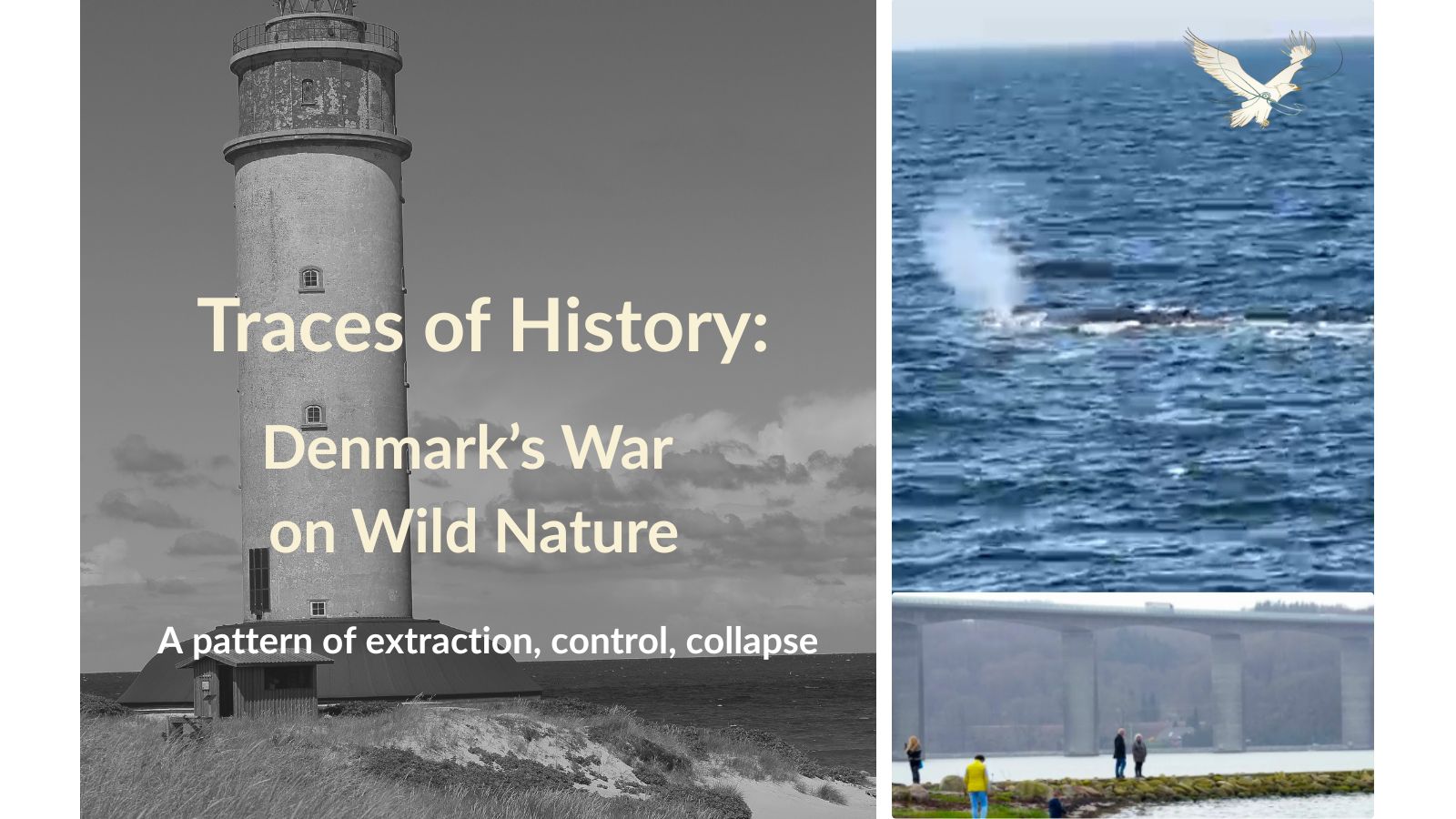
The island of Anholt, where the young humpback whale Timmy (Hope) washed ashore, remains one of Europe's clearest examples of human-caused landscape degradation, where deforestation transformed a forested ecosystem into a desert environment that persists centuries later.
A "desert" created by prioritizing shipping dominance over ecological preservation. Beginning in 1560, to guide navy and merchant ships safely through the treacherous Kattegat strait, Denmark built a massive open-fire beacon on the island. They clear-cut Anholt's dense, ancient pine and oak forests for firewood to keep the lighthouse burning non-stop.
By 1600, Anholt was completely barren. Without trees to anchor the soil, intense Baltic winds caused a massive sand drift. The topsoil blew away, creating a barren, 10-square-kilometer temperate desert that remains to this day.
What happened to Anholt centuries ago perfectly mirrors the Danish authorities' recent decision to butcher Timmy on the beach for industrial use and turn it into biodiesel.
While a "whale fall"— returning a deceased whale carcass to the sea—could nurture and feed an entire deep-ocean ecosystem for a century, Danish authorities decided to cut up the whale, using its parts ...for factories — ignoring other possibilities, pleas, and offers to return the carcass to the Sea.
What the world witnessed on that Anholt beach with the humpback whale wasn't a modern anomaly; it was the same extractive logic that stripped Anholt bare in 1560.
A LEGACY OF MANAGEMENT OVER HARMONY
Historically, Denmark has viewed untamed nature not as a heritage to protect, but as an enemy to defeat and a resource to exploit. An approach that has been seen over and over:
The Eradication of Heaths (1800s):
Following territorial losses to Prussia, Denmark adopted the nationalist motto, "What was lost outwardly, must be won inwardly." The Danish Heath Society launched a massive campaign to drain wetlands and clear the vast, wild, heather landscapes of Jutland, forcing a highly biodiverse ecosystem into rigid, artificial farmland.
The Killing of the Skjern River (1960s):
In a bid to maximize agricultural output, the government turned Denmark’s largest river by volume into a straight, concreted drainage ditch. The surrounding wetlands were completely drained, devastating native salmon and bird populations. Public outcry eventually forced the state to spend millions trying to re-carve its natural curves decades later.
Historic Examples that Reveal a Systemic Pattern:
destroy an ecosystem, realize the damage too late, and then deploy heavy infrastructure to build a highly managed, artificial replacement.
THE DECLINE OF DANISH FJORDS: A VISIBLE, TRAGIC, BIOLOGICAL CASCADE
A "landscape of greed," as described by the European Green Journal. Marked by:
1. Agricultural Runoff:
Industrial pig farming and heavy synthetic fertilizer use flood Danish rivers with massive amounts of nitrogen and phosphorus. In Danish, nitrogen is Kvælstof—which translates to "choking substance."
2. Toxic Algae Blooms:
This flood of nutrients acts as a super-fertilizer for marine algae, causing explosive blooms. They form a thick, suffocating carpet over the water, blocking sunlight from hitting the sea floor.
3. Fedtemøg (Fat Dung):
The resulting foul smell of rotting algae is known locally as Fedtemøg. This word became an omnipresent reality along coastlines due to its sheer scale.
4. Anoxia (The Dead Zone):
When the massive algae blooms die, they sink to the bottom. Bacteria consume them, exhausting all dissolved oxygen in the water. Oxygen concentrations in several inner seas have plummeted to less than a quarter of normal levels, leaving the seabed entirely devoid of life.
Causing a myriad of environmental casualties:
The lack of sunlight has caused eelgrass and seaweed stocks to shrink by more than two-thirds, removing the baseline ecosystem for crabs, mussels, and juvenile fish.
Commercial species like cod, flounder, and eel face local extinction in affected zones.
DENMARK TODAY? FROM SEAFARING TO PHARMA STATE
Denmark's historic view of nature as an expendable resource to exploit is not a thing of the past. Today, the nation's economic pride has shifted from seafaring and agriculture into a hyper-digitized, cashless, technocratic, pharma state.
The crown jewel of this "new economy" is the global dominance of metabolic drugs like Ozempic —revealing a profound pattern parallel: just as Denmark's industrial agriculture over-saturates and chokes the natural soil, its global pharmaceutical machine provides synthetic, high-tech interventions to manage the symptoms of broken human metabolic health worldwide. Consequently, Denmark’s largest economic sector today depends directly on the ill-health of others.
Denmark’s approach to nature has remained nearly identical across centuries. The handling of Timmy (Hope) reflected that.
Whether it is draining the wetlands of Jutland, chopping down the ancient forests of Anholt, dumping Kvælstof into the fjords, or engineering pharmaceutical fixes for human biology — the technocratic mindset treats life as a math problem anchored in corporatism over Natural Law, harmony, and balance.
The lesson?
As Timmy (Hope) showed: don't strand or ever wash ashore in Denmark. It's a graveyard of nature.